
The Bally Story

From a tiny woodworking shop in rural Pennsylvania to a leading name in modern cold storage, the story of Bally Refrigerated Boxes is a classic example of American ingenuity and persistence.
The company’s roots go back to about 1930, when Bally native Leonard Melcher ran a modest shop called Bally Novelty Works, turning out radio cabinets and cedar chests in a two‑story wooden building in town. As the Great Depression deepened, he found a new niche: repairing and then building meat display cases and “ice boxes” for local markets. The demand for these practical products quickly outpaced his earlier lines, and refrigeration became the heart of the business.
In 1932, Melcher’s expansion gained real momentum when he teamed up with George M. Prince of Pottstown, Pennsylvania. Prince took over the sales side, and together they began selling refrigerated cases well beyond their immediate region. By January 1934, their partnership was formalized under a new name—Bally Case and Cooler Company—and a growing factory footprint in Bally. Over the next couple of decades, that once‑small building was enlarged repeatedly as the company’s reputation spread across the country and overseas.
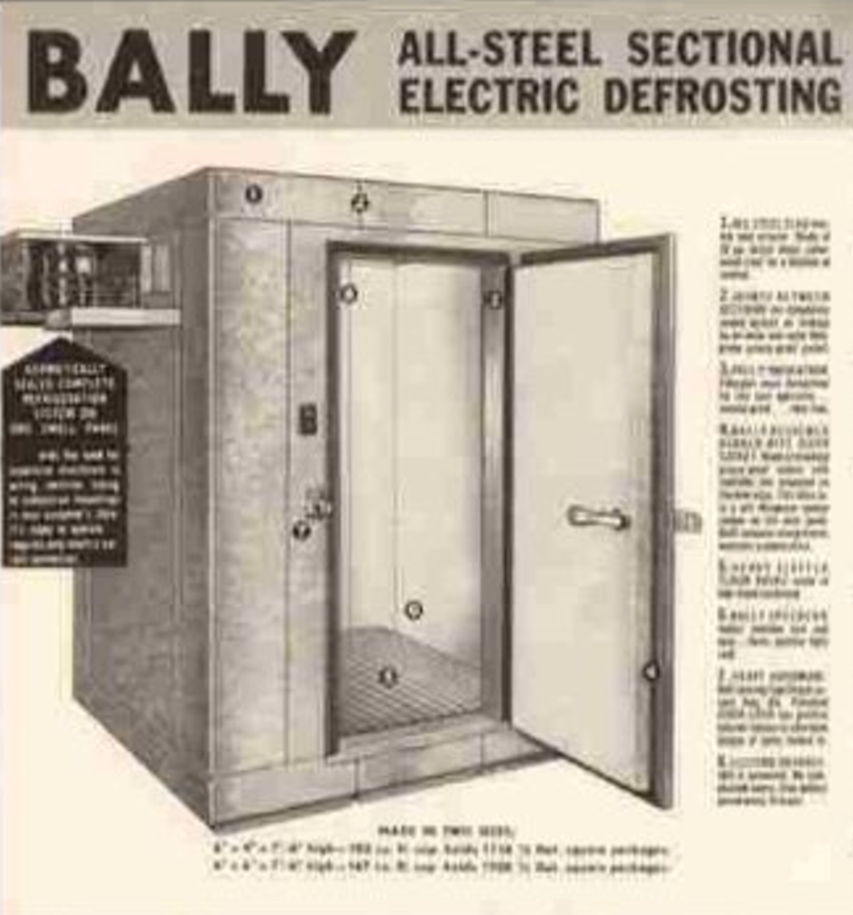
The postwar years brought rapid change in how America shopped and ate. Supermarkets and self‑service food stores sprang up by the thousands, creating a huge need for reliable, efficient refrigerated storage. Bally met that need by pioneering pre‑engineered, prefabricated insulated panels for walk‑in coolers and freezers. These “Bally refrigerated boxes” could be assembled into custom cold rooms and warehouses, and they soon appeared in supermarkets, restaurants, hotels, schools, hospitals, industrial cafeterias, and more. Distribution through a wide network of refrigeration and food‑equipment dealers helped cement the Bally name as a trusted standard in the food industry.
Innovation was not limited to refrigeration alone. In 1947, the company installed a modern porcelain enameling plant, giving Bally the ability to make durable, attractive enamel parts not only for its own cases but also for other manufacturers in fields like lighting, appliances, and architecture. During World War II, the company contributed to the war effort by supplying walk‑in coolers to the armed forces, further proving its reliability under demanding conditions.
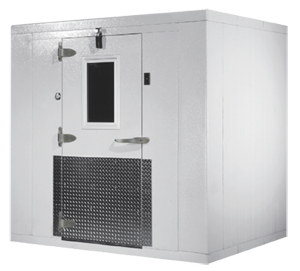
As the decades passed, the company underwent changes in ownership and structure, and its center of gravity shifted south. Manufacturing ultimately moved from its original home in Bally, Pennsylvania, to Morehead City, North Carolina. There, the firm continued the tradition of precision manufacturing, now with computer‑assisted design and production. Today, under the Bally Refrigerated Boxes name, the company is known for walk‑in coolers and freezers, modular structures, refrigerated warehouses, blast chillers, and specialty applications such as mortuary coolers and institutional kitchens.
What began as a craftsman’s response to local needs in a small Pennsylvania town has grown into a national presence in commercial refrigeration. The Bally story is, at its core, a story of adaptation: from woodwork to refrigerated cases, from single stores to global distribution, and from a two‑story shop in Bally to a modern manufacturing facility on the North Carolina coast—always focused on keeping the cold where it’s needed most.