

By Joe Ferri, AKA the FoodiEquipper
Pruning the Commercial Kitchen
What should we preserve, improve, or replace in the next generation of foodservice operations?
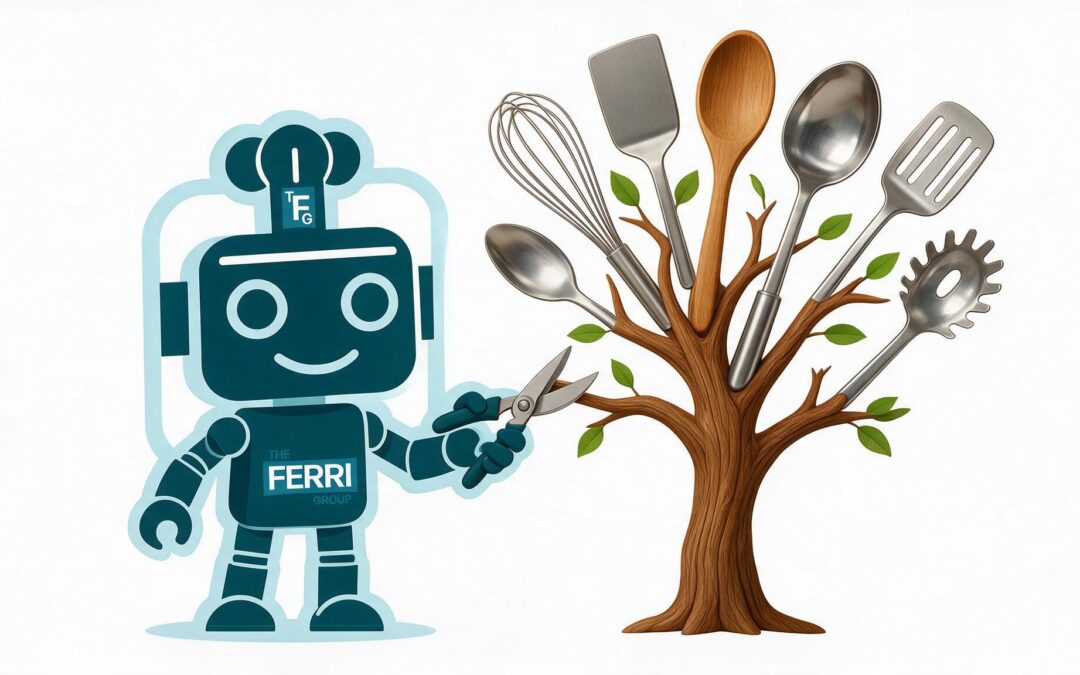
As autumn leaves fall, the branches beneath them are exposed revealing the trees’ framework: the limbs that support growth, the crowded branches competing for space, and all the weak points which may need attention.
Our commercial kitchens deserve the same unmasking.
Strip away the familiar equipment lineup, established routines, and “we’ve always done it this way” assumptions, and what remains? A framework built to support the operation—or an accumulation of decisions that no longer serve it?
For operators, specifiers, and dealers that distinction should shape the next conversation about equipment investment. The question is not simply what to buy. It is what to preserve, what to improve, and what to stop doing altogether.
Examine the branches
Familiarity has its advantages. Operators know their own equipment. Dealers understand the products they sell. Specifiers can recommend with confidence the solutions that they have trusted.
But familiarity should not exempt a product, process, or station from scrutiny.
An established design may remain the right answer. It may need only a minor adjustment in capacity, placement, controls, or supporting infrastructure. Another may deserve a more fundamental rethink. And an activity that once required a dedicated piece of equipment—or an entire workstation—may warrant a different approach.
The objective is not to prune for the sake of pruning. It is to distinguish the branches that support the operation from those that consume resources without delivering enough value.
Start with a straightforward question: If we were designing this kitchen today, for this menu, this workforce, and this volume, would we make the same choices?
If the answer is no, the next question is why.
Find the low-hanging fruit
The most useful starting points are not necessarily the most technologically exciting. They are the tasks that create the greatest daily friction.
Look first at work that is dirty, dangerous, repetitive, or physically demanding. Then examine stations where speed, consistency, and cost control are critical.
Establish the benchmarks by measuring the current costs. Ask questions like: “Which processes depend too heavily on the knowledge of a single experienced employee?”
Operational needs, rather than product features, should drive the discussion.
Before considering new equipment, one should examine the processes in place already – preparation, loading & unloading, holding, and delivery.
Replacing the wrong branch will not strengthen the tree.
Fact-finding should be a collaborative effort amongst the various contingents. Operators and their staff, designers and suppliers all need to be on board.
Put labor where it matters
Labor must be a key component of any survey, reallocation of which should lead to big gains in efficiency.
Human interaction cannot be eliminated. New processes might introduce additional responsibilities for programming, cleaning, monitoring, and maintenance, but should ultimately release additional employee hours back to management.
Reducing waste while improving food quality, consistency, throughput, service, and guest experience should be the ultimate goals of staff realignment.
Considering today’s scarcity of skilled personnel, robotics and automation can create the opportunity to make better use of the employee’s judgment and experience at other in-house positions.
A technology investment should support not only the task being changed but also the operational benefit expected from that change.
Give technology a job
AI and automation have led us to reconsider what equipment MIGHT do. But the practical question is: what job do we NEED it to do?
Vendors must explain the offering’s capability in plain language. What does the system detect, recommend, adjust, or record? What must an employee still do? What information does it require? How will the operator determine whether it is delivering value?
Operators should understand how equipment operates under all conditions, if an employee makes an error, or a connected service becomes unavailable.
Innovation should earn its place in the kitchen by solving a defined problem, not by adding another layer of complexity.
Plan beyond the purchase
The experienced vendor should provide deployment, implementation, integration, training, serviceability, and parts availability. All parties need to know who is responsible for installation, commissioning, staff instruction, and follow-up support.
Site surveys should include available space, delivery conditions, utilities, and ventilation and must be conducted prior to any successful install. Workflow and maintenance practices should be addressed in advance as well. Operators deserve to know what support will be available after installation—and who will provide it.
Consider making these expectations a part of the project requirements.
Like a tree, a commercial kitchen is a connected structure; changing one branch affects all the others.
The task ahead is not wholesale replacement, nor is it unquestioning preservation. It is deliberate pruning: retaining what works, improving what can work better, and removing what no longer serves the operation.
In our next installment, we will move from the forest to the trees, examining specific tasks and equipment categories where that process can begin.